
Strategy System at KIT
We live in a time of constant change. In response, KIT’s new strategy system is structured in three phases—designed to provide long-term orientation while remaining flexible and adaptable. With the vision “Science for Impact”, President Jan S. Hesthaven has articulated KIT’s ambition to actively shape the future. It expresses a set of values and defines what KIT stands for—today and in the years to come.
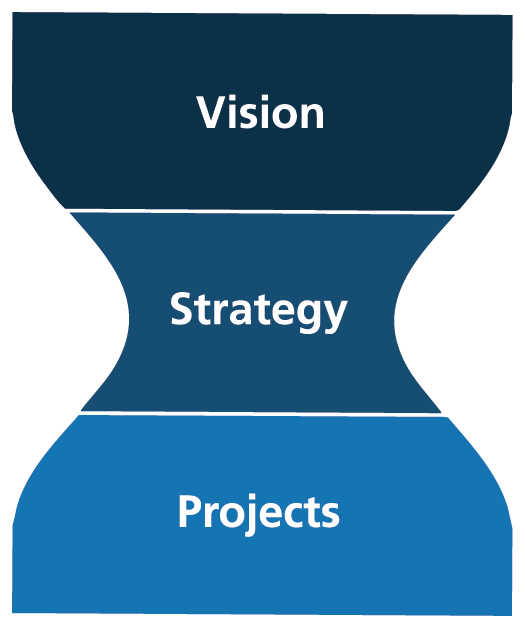
Vision
How do we envision KIT as a scientific institution of the future?
KIT Vision „Science for Impact”
5-10 Years
Where are we at?
We are currently in Phase 2, which focuses on defining the prioritized strategic goals that will shape KIT’s future development.
To this end, approximately 50 colleagues are working across seven working groups (WGs), focusing on key development areas and a cross-cutting theme that spans all groups.
The development of these strategic goals is intentionally participatory, as it requires the diverse perspectives of the KIT community. Each working group is therefore composed of six experts, jointly appointed by the respective group leads—members of the Presidium or the Vice Provosts—and the KIT Senate. They act as representatives of KIT as an institution. The groups were put together with the aim of ensuring a balanced, representative, and future-oriented composition.
By late summer, the working groups will have developed their topic-specific goals, which will then be consolidated into a prioritized list by the end of the year.
Open Feedback
We would also like to give all KIT members the opportunity to contribute. To help inform your input, the brief descriptions below outline the working groups’ topics and objectives. At this stage, the focus is not on individual measures (e.g. digitalization of the business travel process) but on overarching development goals for KIT as an institution (e.g. KIT-wide digitalization of central services and administration).
Do you have relevant input to share? We welcome your contributions—please submit them via the respective functional email address.
Topics:
Cultural Transformations
Empowering Science
Impactful Organization and KIT Community
Innovative Education
Promotion of Scientific Careers
Service Excellence and Process Effectiveness
Turning Science into Solution
Cross-Cutting Theme "Scientific Infrastructure"
Cultural Transformations
Cultural Transformation operates on two levels: The first level addresses two major ongoing and urgently needed transformations: digitalization and sustainability (in research, teaching, transfer, and at KIT as an institution), as well as equal opportunity and diversity (at KIT). The focus here is on identifying the key impact-relevant gaps in the existing set of goals and measures. The second level looks at cultures of collaboration, mindsets, and habits that hinder impact, focusing on three key areas:
- Agile ways of working and a constructive approach to errors and failure in research and other fields of activity;
- Reducing the structural culture of mistrust, fostering a culture of appreciation, and strengthening the principle of subsidiarity; and
- Positioning KIT—and its campuses—as an attractive place (to be).
Empowering Science
We focus on strengthening KIT’s research strategy to enhance our excellence, visibility, and impact in the scientific community as well as society. While building on disciplinary depth, unique research infrastructures, and strong collaborations, key challenges lie in sharpening shared research goals, increasing focus in thematic priorities (especially KIT’s research foci and emerging fields, including their life cycle), and better leveraging interdisciplinary collaboration—particularly through the further development of the KIT Centers. The central objective is to improve strategic portfolio steering, strengthen excellence oriented third party funding and collaboration pathways, and enable a research community capable of driving innovation across the entire scientific continuum while remaining agile, competitive, and future ready.
Impactful Organization and KIT Community
We focus on strengthening the alignment between organizational structures, governance, and community to better enable institutional impact. While building on strong professionalism, leadership potential, and a shared belief in the institution, key challenges lie in addressing role clarity, reducing structural complexity, and fostering a more outward-looking and courageous mindset. The central objective is to identify organization-wide development potential that enhances strategic steering, strengthens ownership and accountability, and enables a community capable of navigating change collectively while remaining focused, adaptable, and future-ready.
Innovative Education
Our goal is to strategically develop our academic offerings and strengthen modern educational approaches. Key components include the integration of future-oriented skills and project-based teaching methods. By closely integrating our outstanding research infrastructure into teaching, we aim to strengthen the KIT brand internationally in the long term. The key objective is to shape the entire student lifecycle in a future-oriented manner—from choosing a program of study and student life on the KIT campus to engaging KIT alumni. By fostering and supporting the engagement of students and alumni, we can retain, nurture, and provide ongoing support to our talent throughout their academic and professional careers. The comprehensive expansion of our lifelong learning offerings will be a key component in this process. The consistent internationalization of our educational programs in terms of their content and organization enables us to actively promote global talent. By closely integrating research and teaching, we leverage KIT’s unique selling point as the University in the Helmholtz Association, thereby creating a sustainable, integrated educational environment.
Promotion of Scientific Careers
We focus on the key areas of framework conditions, recruitment, attractiveness, qualification, and career development. These topics are addressed with varying intensity and a tailored focus for their target groups of doctoral researchers, postdoctoral researchers, junior group leaders, junior and tenure-track professors, and permanently employed research staff. We aim to enhance attractiveness of KIT by establishing clear and easily understandable structures and processes.
Service Excellence and Process Effectiveness
We focus on aligning the interface between science and administration in a way that our common mission is supported best. Thereby we build on the strong expertise and dedication of our administrative staff. Our goal is to identify organization-wide potential for improving the quality of service and the effectiveness of processes, to find an effective balance between standardization and flexibility and to create administrative workflows that serve reliable support for science. Digital services and processes help us to achieve these objectives. The central challenge is to define clear tasks and authority and to foster a culture in which science and administration communicate on an equal footing, value each other and assume responsibilities.
Turning Science into Solution
Scientific excellence gains its full societal value when research results are transformed into solutions. This process requires an ecosystem that enables innovation: from scouting and mentoring to financial support and suitable employment models along the path from idea to application. The transformation of knowledge into practice is not limited to commercialization but also includes broader contributions to society through transdisciplinary and participatory research, and partnerships with diverse stakeholders.
To achieve this, we monitor and analyze how to identify, foster and enable innovation potentials across disciplines and groups, ensuring that underrepresented fields and talents are recognized and supported. We strategically foster our alive ecosystem: spaces of encounter and exchange with alumni, industry, and the public community strengthen engagement and make our offers and results visible to the inside and outside of KIT. We strategically focus on understanding and developing the concept of transfer, the culture of transfer, and relevant transfer skills as well as society's needs and contributions.
What's next?
The results of Phase 2 provide the foundation for Phase 3 of the strategy system.
The prioritized strategic goals developed in Phase 2 are translated into concrete measures and projects with a one- to two-year horizon. The aim is to develop a coherent and prioritized KIT strategy as an operational framework for implementing the vision “Science for Impact”. In this way, long-term direction is gradually turned into actionable steps.
Jan S. Hesthaven
Project Owner
president@kit.edu

Ruth Schwartländer
Gesamtkoordination
ruth.schwartlaender@kit.edu

Nadja Lodes & Jonas Meier-Arendt
Team Gesamtkoordination
nadja.lodes@kit.edu
jonas.meier-arendt@kit.edu